Showing posts with label Professional Development. Show all posts

Thursday, 26 November 2020

Masters in Teaching English as an Additional Language

    Today I graduate with immense satisfaction. After a 23-year hiatus from post-secondary education, I returned for a master’s degree. When I last graduated, with a B.A. and a teaching program, the internet was barely a thing. I no longer remember the specifics, but I logged onto a particular university database and a statistical software program with mysterious codes and instructions. Then in 2018, I began a two-year online program.

    Fortunately, from 1995-2018, I hadn’t been living in a cave without access to technology. Therefore, I had some knowledge of how online learning worked. My steepest learning curve was online research. Manoeuvring the online library and databases might be easier now but without any instructions it wasn’t exactly obvious either. Ironically, the last couple of courses I took came with some great tips, tricks, and advice from the experts.

    I had been wanting to do my master’s degree for a long time, but I was lacking the necessary resources. Then a door opened. I squeezed through and took a leap! Any number of crises could have happened that I would have been unprepared for, and then I quite possibly would have regretted my decision. Despite a global pandemic, my life remained crisis free and the results of my decision to leap have been all positive.

    I mention this struggle because I think that it is important for us educators who are privileged enough to get the schooling that we need and/or want, to remember that circumstances can be drastically different for others. During my 25 years as a teacher, I have seen many instances of how privilege can create systemic biases in our teaching institutions. The vast majority of times, these biases aren’t questioned. In a recent news story, a B.C. mom went to the media about a homework assignment her daughter had been given. Her child was asked to list 5+ positive stories or effects of the BC residential school system. It is a horrendously offensive error that I can imagine being made by someone who is privileged enough to not realize that using ‘focus on the positives’ mindset that is common and useful for privileged people, is not always appropriate or beneficial. Had this mother not gone to the media, I could see that this would be one of those unquestioned examples.

    My frustration with the negative effects that come from a lack of awareness for privileged bias, likely played a role in my choice of research for my capstone project that addresses a topic that could be extremely beneficial for both those that lack opportunities and resources and those who do not. Promoting metacognition among language learners can only be beneficial. Twenty-five years ago, I began teaching with a desire to deliver a fairer and less biased education than what I had experienced. I believe that along the way, I have stayed true to this passion despite the long hours if often required. Now, I am even better equipped to help my students help themselves long after their time of learning with me is over. I also have hope that I can influence other educators to be more responsive to the needs of those who do not come from circumstances that make the pursuit of post-secondary learning easy or realistic.

    When I applied for this masters program, I had to list what I hoped to gain from the experience. I remember that there were three main topics that I hoped to gain knowledge and understanding with. First, I wanted to better understand the unique needs of learners for whom English was not a first language and yet were being educated in English. Secondly, I had no idea how to teach grammar as it was not an area that I had specifically received instruction in as a K-12 learner. Additionally, I had not been taught anything about teaching grammar in my undergraduate pursuits. Yet, my experiences with English language learners had helped me understand that grammar needed to be addressed. Both of these topics were specifically and explicitly addressed in the University of Calgary’s M. Ed. program that specialized in English as an Additional Language. As a result, I certainly feel that I have a better understanding in these areas.

    The final inquiry that I listed was not specifically addressed, yet I have absorbed some ideas to answer it. I do realize this inquiry was a very tall order and not likely on the minds of too many other people. It was to understand how I might use technology to help disadvantaged learners around the world have better and more equal access to learning English as a foreign language. Although there clearly are not any obvious and specific answers to this question, I do feel that I have some very good ideas on how I can pursue some possible solutions that might address this query.

    Although I would have loved to have flown out to the University of Calgary and attended my well-earned convocation, a virus decided otherwise. I guess it is fitting that after completing an online degree, I attended an online convocation. Either way, I benefit. I have learned, evolved and grown as a person. Today I am proud of myself.

    I would be remiss if I did not acknowledge all the help and support that I have had on my journey. I thank my professors for teaching what they knew. I am immensely grateful for those professors that went beyond the basics and gave feedback, encouragement, and advise. Thank you to my cohort of peers who were such amazing people. Not only was I able to learn form these wonderful and brilliant individuals, I was also able to share and bounce ideas around with them. Thank you to my daughter, family, and friends who were patient and supportive with me when I had a lot on my plate. Thank you to my references. One of my biggest hurdles was asking two fabulous individuals to be my references. It is incredibly hard for me to ask other to do things for me. It was my first hurdle in this achievement, and I am grateful for their graciousness. Thank you to my students who gave me purpose, practice, and passion!

Friday, 21 October 2016

George Couros – Innovator’s Mindset October 21st, 2016

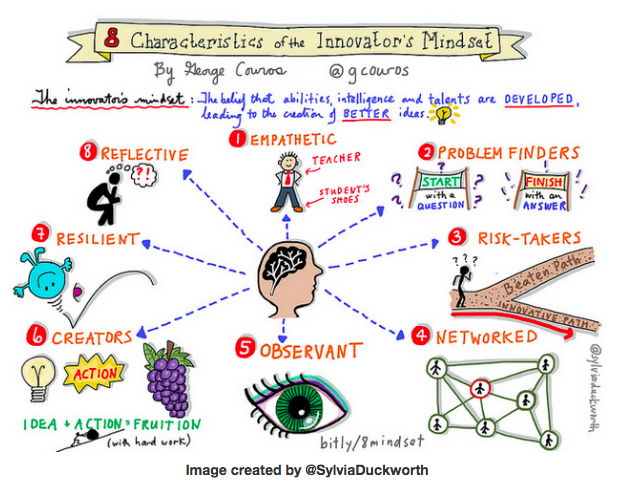
Today I saw George Couros, the author of The Innovator’s Mindset speak at the Langley Event Centre. George reminded us all that the goals of school versus the goals of learning are not always consistent and that it is our job as educators to prepare students for a largely unknown future. The best way that we can do that is to help them develop an innovator’s mindset and to do that we need to cultivate it in ourselves.

Favorite graphic of the day:
Favourite quote of the day:

George asked us, “What is one thing that has been reaffirmed today? What is one thing that has challenged you? What is one thing you are going to try?” Here are my answers: Something reaffirmed for me today was the idea that we need to let children create during their time at school! A challenge for me in teaching more innovatively has been getting technology that isn’t outdated into my classroom. Finally something I am going to try is improving my Twitter literacy.

Favourite take-away:
3 things students should have before they leave high school:
1.     A professional social network
2.     A digital portfolio
3.     An about.me page
And teachers should have these too!

2015/16 Ongoing Professional Development Throughout the School Year

In addition to professional development days, which I was negligent in blogging about this school year, two great Pro D opportunities I had was the collaboration/inquiry time worked into our school year and a book club at my school.
During the Inquiry/Collaboration time, I delved into the question of whether online Fresh Grade (FG) portfolios could improve my communication to parents about their children’s learning. Working with five other teachers at my school, we all found that it was a terrific tool for communicating what we were doing in the classroom and where each child was at with their learning. We could post pictures for the whole class to show parents activities like a Science demonstration, a group writing collaboration, a guest presenter or even a class demonstration of a dance. This provides parents with an insight as to what their child actually does at school and can help them further the discussion if their "what did you do at school today?" question is answered with "nothing" or “I don’t know.” FG also has an announcements feature that allows a teacher to send out an announcement such as a reminder and parents will be notified via a pop up if they have the app and an email. I would say the most powerful feature of FG is the ability to post pictures and videos of a student to demonstrate where they are at with their learning. For example, we posted pictures of drawings, projects, writing samples, and assessments as well as videos of counting, reading, and answering open ended questions. These can then have a note attached to them explaining what the teacher was looking for. If you attach a learning outcome to these activities and assess them as you post them. These learning outcomes and their attached assessment will be automatically used when you create a report card for your students. We all found FG to be such a useful tool for communicating with parents that we are each using it again this year. We received lots of positive feedback from parents.

Another ongoing learning experience that I enjoyed was a book club hosted by our vice-principal, Kim Anderson for Catching Readers Before They Fall by Pat Johnson and Katie Keier. A group of us met regularly throughout the year to discuss the chapters as we read through the book. I found this a great experience! Although I had pretty much learned most of the strategies and concepts brought up in the book through professional development over the last 21 years, it really helped freshen my perspective. There were so many ideas that I came across and realized that I either hadn’t done them in awhile or I had meant to incorporate them into my teaching at some point and then never did. As well discussing the topic of teaching reading to the students who don’t pick it up easily was valuable. We shared our ideas on how to find the time to spend the extra time needed with these learners. I’m very grateful for this learning opportunity!

2015/16 Pro D as a Digital Literacy Coach

Although my tech skills aren’t anything I would ever consider writing home about I agreed to help out my staff by taking on the position of Digital Literacy Coach back in January 2015 because I am passionate about the advantages technology can bring to education. The best part about taking on this role was the professional development opportunities it provided.
As DL coaches, we were provided with a couple of days of Pro D the week before school started and a 1-night/1-day Pro D conference in October. For me the biggest take-aways on these days was learning how to use iBooks Author and more presentation tools and strategies.
Here is a link for two ebooks that I wrote using iBooks Author:
One was created for our district’s iTunes channel and for parents who ask me how they can best help their children at home. The other was for our school website when some of the teachers at our school put on an event to help parents learn ways to help their children with their writing.
Another great experience was applying for the Langley School District’s Zone of Innovation Grant. Part of the agreement for getting five laptops for our school was to summarize and report on the ways we used them through an iTunes U course. I enjoyed learning the process of putting together an iTunes U course called Adventures in Literacy that can be found on Langley’s iTunes U channel: School District #35.
While helping my colleagues with their tech questions, I was also able to learn of lots of cool things that they were learning and exploring. I was able to report on some of the great ideas my staff was exploring in a blog that the districts DL coaches contributed to. It’s entitled Small Steps for Teachers, Large Strides for Education.
Ironically that’s a good metaphor for how I feel about my experience as a DL Coach. It was a small step for me to agree to be oJKE’s DL Coach but it helped me make large strides in learning more about using technology to provide students with terrific learning opportunities.

Monday, 26 October 2015

Top Strategies for Helping Children Develop Self-Regulation

During the 2015-2016 I had the fabulous opportunity to collaborate with my colleagues Tannis Foulds, Ashley Stenerson, and Lynda Hornby. The four of us were all feeling a strong need to help our students develop their abilities to regulate themselves. After all the better our students can self-regulate themselves then more learning can happen in a calmer and more focused and respectful environment. At the end of the year, based on the research that we had done and the experiences we had in our classrooms, we developed the list below.

Top strategies for anyone who lives with, hangs with, or works with children to help children learn to regulate themselves:

-set boundaries/limits for children
-clear expectations for behavior
-be firm
-help kids figure out why they are doing what they are doing
-help them understand the consequences of their behavior
-help them come up with alternative behaviors
-remind/teach manners
-model the language i.e. how are you feeling?
-use “when...then..” consequences and following through consistently
-deep breaths
-self-talk
-teach mindfulness, i.e. chime, breathing
-model our own self-regulation strategies i.e. self talk - “well I’ve done all I can do now so I just need to stop worrying”
-self-sufficiency - teach kids to do things for themselves - age-appropriate responsibilities
-plan ahead and help children understand what is coming up that day, or that week
-model empathy
-encourage well-rounded interests while supporting strengths
-teach/train kids to focus for age-appropriate time lengths

Friday, 1 May 2015

Odyssey '15 on February 20th, 2015

Sometimes when a Professional Development day falls so close to a report card deadline it can be a tad challenging to keep my mind on all the new ideas being presented and feel excited to get back to my classroom and try new things. However this Pro-D day was exceptional! I really enjoyed the three sessions that I attended and took away lots of solid and fledgling ideas on things that I want to try in my classroom. I feel excited to implement what I learned and the ideas that I formed while there.
My first session was “DL Coaches Unite!” presented by Sandra Averill. The main point of this session was how to help promote digital literacy in our schools. Personally I came away with three exciting ideas that I plan to implement. When it comes to using the iPads with the students, a real thorn in my side has been the amount of troubleshooting that I end up doing. When I spend so much time trying to solve problems and then pairing kids up because we can’t resolve issues with certain iPads, it leaves little time for actually doing meaningful learning activities. Sandra helped me come up with a plan that I think will help immensely. Stay tuned for a future blog entry on how that plan goes! We also discussed a few creation apps that I would like to explore further with story writing. Finally, we had been discussing some simple ideas that might be of interest to teachers who are a little more leery of technology and out of that I formed a terrific idea that would mesh well with my school’s reading goal. I plan on teaching my students to record themselves reading in PhotoBooth on my teacher laptop. Their job will be to pick a “good fit” book to record themselves reading. The idea behind this is to encourage them to hone their skill at choosing a “good fit” book but when the kids get efficient at it, I will have some recorded reading assessments and still be able to monitor the rest of the class. Plus the children get to choose their own reading material which is another aspect of reading that our school wants to work on.
The second session I attended was “Inquiry-based Learning in Grades K-3” presented by Brenda Boylan. I have heard others speak on inquiry learning a few times and I did a lot of inquiry learning when I taught intermediate. However primary comes with the challenge of students with less independence and less self-regulation. Brenda really helped me envision more ways of bringing inquiry learning into  my primary classroom without sacrificing a healthy learning environment. I already bring a lot of inquiry thinking skills into my Science activities. We do a lot of activities where we think like a scientist and determine what we will do to answer a scientific question. Then we make a prediction, carry out our experiment, record our observations and reflect on what we learned. After Brenda’s presentation, I will try some of the activities she suggested that promote inquiry-based thinking skills like: Object a Week, Wonder Window, Inquiry Notebook or Wonder Book, and I would like to post her Recording Thinking Prompts at my writing centre for writing prompts. Brenda also suggested books to read to our students about inquiry-based learning and she gave us some Scholastic Literacy Place Inquiry Unit book lists as well as their  Inquiry Process poster. Gotta love a ProD presentation that gives free stuff!
My last session of the day was “iMovies” presented by Katie Ropchan. Katie showed us a few examples of how we might use iMovies in our teaching: to introduce yourself, to showcase clubs, and for student projects. As a primary teacher I would like to have an iMovie going during Student Led conferences to highlight learning activities and one to show at the end of the year to celebrate the school year. Katie gave us a handout that addressed the different areas that we might want to use like: importing, transitions, themes, or music. I’ve played around with iMovie before but I got a lot more done while working on it in a group with Katie’s support and the handout. I even had a clip of all the photos that I’ve taken of my students this year that I was able to show them on Monday!
I really enjoyed Odyssey ‘15. So grateful to SD#35’s Professional Services for organizing a Professional Development conference with so many choices. It allows me to choose presentations that are meaningful and inspiring for my teaching practise.

Saturday, 25 October 2014

Peer into the Future of Education by Alan November

This was the conference that I attended yesterday. I have to admit that on my way there, I had been hoping that it would end early because I had so many errands to run. But it did not end early and I was not disappointed because it had succeeded in making me think! More specifically, it made me think about how technology can help us teach better than ever.

The first example that November gave us that illustrates the change in what we can teach and now expect from our students, is how we are no longer limited in the sources of information that our children have access to. If we give students an assignment to write about an event in history they are no longer limited to using only sources from their own country. They can access sources from other countries to understand other perspectives on that event and then learn from these differing perspectives.

Of course this access to other sources also means that we have lost control over what sources are available to our students and it is critically important that we teach them to analyze what they read. Two very important elements that we need to teach them is to look at who is producing the content that they read and how to confirm which of two conflicting sources is correct. The examples that November gave us for teaching who is producing content were a “.org” page owned by someone who does harm to that cause and an article that superficially looked like it was produced by a well renowned university but was actually produced by a student at that university who did not have his facts straight.

Alan November also showed us numerous websites that offer terrific learning and teaching opportunities. Here are some that I intend to explore further: Diigo, WolframAlpha, Kaizena, Mathtrain.tv, Clubacademia, ScreenChomp, Scratch, Edx, FanFiction. I have to admit that none of the things discussed at this conference were things that I could do with my early primary class that I currently teach. However I did spend much of the day thinking about what skills we should be teaching our students in the early primary grades in order to enable them to be successful learners in tomorrow’s world.


It does seem reasonable to expect that the future of learning will be more about setting up individualized learning programs for children and the teacher’s role will be to assess where a student is at and use that information to create a learning program for them. For students to get the most out of this type of a learning program it is more important than ever for them to be independent, motivated, and capable learners. This means that early on in their education we should be teaching children to learn how to learn. In my online course, Learn Easier Study Better, I stress that learning how to be a better learner involves understanding  knowing how to motivate oneself, having a “can-do” attitude, developing confidence in one’s abilities, knowledge of the learning process, and good practical learning strategies. These are all things that we can and should teach our children starting at a young age. My passion for teaching my students how to learn better was definitely fed at yesterday’s conference!

Wednesday, 6 August 2014

Teaching Online

Two years ago, I decided that I wanted to create an online course. I knew what I wanted to teach but I did not know how I could teach it online. Then a year ago I heard about Udemy. After checking it out I realized that this would be the perfect platform for my course! So over this past year, I have been researching, planning, and writing my course. As well, I took a course on Udemy on How to Create a Udemy Course.

The easy part is done. Now I am working on getting my course published. While writing the course I was in my element. I had been researching learning and study skills for well over a year and I am very passionate about the idea of empowering students to become more independent and in-control of their learning. Now I am plugging away at the technical aspect of creating and editing high quality videos. Ironically, I have had to take my own advice that I give in my course on maintaining my motivation, improving my confidence in my abilities, and being patient with my learning process.

When I feel stuck, I turn to three options. One, I go back to my notes or the course itself. Two, I take a break and turn to the new and improved Udemy course How to Create Your Udemy Course. After all, repetition is key! That is another key concept in my course, Learn Easier Study Better. Third, I sleep on it. Sometimes for more than one night. I think that I'm over the toughest part. So hopefully my next post will be when my course is done. Or if I need another breather, it will be on one of the books that I read this summer. Wish me luck!

Wednesday, 7 May 2014

May 2nd, 2014 Professional Development Day

I attended the School District #35 sponsored professional day conference for WGSS feeder schools. The keynote speaker for the morning session was Lynie Tener who spoke on Exploring Learning and Teaching. Lynie Tener spoke to the idea of teaching to all students not just the capable ones. She presented a lot of Carol Dweck’s research, particularly her findings for the different effects of praising children for their ability and praising them for their effort. When praised for their ability, students tend to refuse challenges so that they don’t prove themselves unable and they experience more anxiety when presented with more challenging work. But with praise for effort, children were more likely to accept challenges and deal with failures as learning experiences. This has been much quoted research of late and I struggled to remember who I have been reading lately that has also gone into these findings in detail.
Then Tener spoke more about Carol Dweck’s work on a growth mindset versus a fixed mindset. With a fixed mindset, people tend to believe that their intelligence is somewhat fixed and there isn’t a lot that they can do to improve it. They shut down with criticism, avoid challenges, and do what they can to make themselves look smart. With a growth mindset, people know that their intelligence can improve. They believe that their knowledge and abilities will improve with hard work. Criticism and setbacks are just tools for learning.
Finally, Lynie Tener spoke about the OECD’s 7 Principles of Learning. She expounded on each the principles; learners at the centre, the social nature of learning, emotions are integral to learning, recognizing individual differences, stretching all students, assessment for learning, and building horizontal connections. Then she had us to some reflection on how we teach in regards to these principles.


For my second session I attended UDL: Universal Design for Learning given by Anne Midzain. She explained that the philosophy of Universal Design for Learning was about getting to know your students as a community of learners as well as individual learners. Then you start by looking at their strengths. When using this model we teach with the three principles: Representation, Action and Expression, and Engagement. Anne Midzain also gave us the following websites to explore: www.udlresource.ca, udlresource.com, and cast.org. This is a model that I am very interested in learning more about!

The final session I attended was Primary Genius Hour given by Tracy Cramer. I have been interested in Genius Hour for awhile now but have struggled to picture how to put it into practise with a class of 24 grade one and two students with just me. I have heard teachers of intermediate grades express frustration with implementing it due to the lack of independence among many children these days and with maxed out class sizes the lack of independence is even more taxing. This session gave me some great ideas! First of all she had her students partnered up with “inquiry buddies”. These were older buddies who can write! Another good idea is to start with a class topic. That way she gathered research material on that topic. The students were able to research different subtopics of that class topic. With just these two details, I have a much clearer idea of how I might implement this kind of inquiry into my classroom for the next school year!

Monday, 3 March 2014

February 21st 2014 Professional Day

On February 21st, I attended Think Langley's #odyssey14 conference. I attended 3 sessions.

Daily 5: Question and Answer Session - I attended this session because I had read the book years ago when I was still teaching intermediate. Now I'm back in primary and reading The CAFE Book. I felt a refresher would be helpful as well as the time to look at the Daily 5 through primary eyes. I am happy to say that I did get some good ideas for "word work" apps as well as encouraging learning independence and stamina.

Explain Everything! Practical Uses and How-Tos For Screencasting on Your iPad - Kudos to Victoria Olson for being so organized. Here is slideshow that went with the workshop. We played around and got our hands "dirty". Originally, I choose this workshop because I'm interested in learning more about screencasting to present ideas on brain-based learning. However, I must say that I was impressed with the practical classroom applications that Victoria showed us. Having students read a passage or explain a math concept are the ideas that excited me most!

So You Want to Mystery Skype? - Okay, I have to admit, I choose this workshop by default as all the ones I was really interested in were full. I think Mystery Skype is a pretty simple concept and was pretty clear when Will Richardson explained it at the Learning in a Networked World (see earlier blog). This workshop was  facilitated by Victoria Olson as well and she gave us lots of ideas about what jobs there are for students to take on and then we actually did a Mystery Skype. So I do feel quite prepared to do this in the classroom and I've even found a class to do it with!

Wednesday, 15 January 2014

Inspiring Leadership through Emotional Intelligence

Wow, I took my first course through Coursera! What a great experience. I took the 8 week course Inspiring Leadership through EmotionalIntelligence. It was offered by Case Western Reserve University and the Instructor was Richard Boyatzis. It was an 8 week course that I worked on from October 28th through December 23rd of 2013. It was a great experience and it has turned me into a Coursera fan. I am registered in an upcoming class on public speaking.

The big idea in this course that impacted me the most is that inspiring leaders create experiences of hope, compassion, mindfulness, and playfulness with the people around them. As well, these qualities are important to have in our own experiences to keep us renewed and to ameliorate the effects of stress in our lives. Of course once you think about it, it seems to be common sense that experiences of hope, compassion, mindfulness, and playfulness would help us build resonant relationships and keep us feeling positive and renewed. The course offers up the neuroscience to back up the common sense as well. Being a big fan of neuroscience I enjoyed the readings immensely.

Another big idea that I really appreciated was that of Boyatzis’ Intentional Change Theory (ICT). This theory is basically a model of sustained, desired change for people individually or in groups. Reading and listening to this theory was like a light bulb going off. It was explaining so much of what I’ve seen and experienced but was not entirely conscious of or able to put it into words. Not only does this course explain how one can use ICT to change in the direction one wants to, but it also explains how it can be used to coach others and to develop as an organization.

As a classroom teacher, I am a leader. I think that it is easy to take for granted that because I am more experienced, knowledgeable, and mature than my students then leadership is natural and easy. This course has made me more aware of the importance of building resonant relationships with my students, renewing my own emotional well-being, and coaching my students with the use of hope. I think that most teachers are aware that good relationships in the classroom make for more effective teaching an learning but I haven't typically thought of building relationships specifically for the purpose of leading. Attitude is contagious but so is energy level and motivation and this course offered lots of information and strategies in regards to keep ourselves strong and renewed. By using hope, I can move my students into a positive emotional affect which makes it much easier for them to see how to move forward with their goals and helps them take ownership of their learning.

I found the readings in this course to be very interesting and enjoyable. The lectures were focused and the assignments were practical and really did help me learn the information in a minds-on manner. My favourite assignment was creating a personal vision aimed at creating the experience of hope. Not only did I experience hope while writing it but the vision has stayed with me and I experience hope just thinking about it. I have also gone back and read it a few times already. Thank you, Coursera, Case Western Reserve University, and Richard Boyatzis!

Saturday, 26 October 2013

Will Richardson "Learning in a Networked World"


On October 25th, 2013, I spent the day listening to Will Richardson speak about “Learning in a Networked World”. The theme of the day was for us to consider how the world is changing and how we can best prepare our students for their futures. And to do this how we as educators can learn, unlearn, and relearn how to teach the youth of this fast-paced, globally networked world.

The following quote has been taken from the flyer advertising this event,A parent of two teen-agers, Will Richardson has been thinking and writing about the intersection of social online learning networks and education for the past 12 years at willrichardson.com and in numerous journals, newspapers, and magazines such as Ed Leadership, District Administration, Education Week, New York Times and English Journal. He is an outspoken advocate for change in schools and classrooms in the context of the diverse new learning opportunities that the Web and other technologies now offer.”

Will, frustrated with the education his children have been receiving, feels we need to stop wanting the same education for our children as the one we had. This is an amazing time to be a learner! There are so many ways for learners to connect with others, pursue their learning passions, and apply the knowledge that they learn. He likened traditional learning vs. modern learning to delivery vs. discovery. And emphasizes that the key shift to be made is from institutional learning organizations to self-organized learning opportunities.

When we were asked to reflect on the traditional notions of school and what our biggest confusions/questions are right now, the educators at the table that I was sitting at had many. How do we tap students’ curiosity in our schools? What kind of steps do we take to channel their curiosity? How do we address both students who are overly plugged in and those who are “underly” plugged in? How do we teach kids to be learning tech savvy rather than socially tech savvy? What does it mean to be educated these days?

I appreciated reading and reflecting on the NCTE 21st Century Literacies. I have listed below the ones that I would like to focus on developing in myself over then next year.
  • Design and share information for global communities to meet a variety of purpose
  • Manage, analyze, and synthesize, multiple streams of simultaneous information
  • Create, critique, analyze, and evaluate multi-media texts


Later in the day the focus shifted more towards the idea of us as educators “being a learner first and teacher second”. Will covered a number or technology tools that could be useful to us as educators. The following are the ones that caught my attention. I’ve had a Twitter account for a while but rarely use it. He helped me understand how Twitter could be used more effectively for professional development. I will definitely look into using Evernote to save articles and notes, rather than saving links in a Word document as I have been doing. I am also going to use Feedly to aggregate news sites, searches, and blogs. Later, as I develop more of an online presence I think Flipboard and IFTTT could be quite useful.

All and all I consider the day well spent. I left feeling inspired and motivated to become more of a networked learner myself! I feel better prepared for the changes that are happening and should be happening in my profession.

Monday, 30 September 2013

Challenging Student Behaviour

The final professional development engagement that I attended for the 2012/13 school year was called Challenging Behaviour: Responding to Individual Students. It was sponsored by the BCTF. For the last two years in particular, I have had some very challenging student behaviour and I wanted a refresher on how to meet the needs that drive these behaviours. Fortunately, that is exactly what this workshop addressed. In fact rather than just addressing the goals of attention-seeking and power-seeking misbehaviour, it also addressed the misbehavior due to self-regulation needs, avoidance of failure, and avoidance of pain/humiliation. Even now with starting up my new class, I catch myself looking over these notes in an attempt to determine the needs of some of my more needy students. I'm so glad that I took this workshop!

Professional Development Day in February 2013

On this day in February, I attended three workshops presented through the Langley School District. The first was on "Social Networking in the Classroom with Edmodo". Although I was impressed with the ideas on ways to use Edmodo as a classroom teacher, I confess that I have not acted on this knowledge. With teaching primary, I think I might try a website using weebly instead to communicate with parents. Then I attended a workshop called "Intro to Inquiry". The ideas of inquiry learning are certainly nothing new as this is an age old natural method of learning which I saw used frequently when I worked with homeschooling families. The challenge is how to use this in the classroom when the ratio of students to educators in primary is 24:1. Since the following workshop that I went to was on using PREZI, I decided to make a simple summary on Inquiry Learning with a PREZI during the workshop.Here is my PREZI in Inquiry Learning
Later this summer, I decided to play around with PREZI more as I think it is a great way to present information to today's youth and I developed another one to present a project my daughter worked on with her grandpa. I confess that it took me quite awhile and I ended up using a formatted template as a blank template would have taken me forever. Here is a slightly more sophisticated PREZI that I created.

Stuart Shanker and Classroom Strategies for Self-Regulation

Another pivotal aspect of my professional development in the 2012/13 school year was attending an presentation on Classroom Strategies for Self-Regulation by Stuart Shanker put on by the Langley School District. I attended this presentation with my staff early on in the school year and we were all impressed with Shanker's ability to speak to us about increasing needs of the children passing through our classrooms these days. It was great to have a term to hang on these needs that have been such a demand in our profession as of late, "self-regulation." Shanker helped us see the various aspects or domains of these self-regulation needs, biological, emotional, cognitive, social, and prosocial. He also gave some practical strategies that we could implement to promote a calmer learning environment. I was so impressed with the ideas presented that I purchased his book, Calm, Alert, and Learning.
Calm, Alert And Learning: Classroom Strategies For Self-regulation
This book has made a significant impact on my teaching style and helped me embrace my un-teacher like quality of not wanting the walls of my classroom to be so bright and crowded with visuals! The ideas in this book complimented the MindUp curriculum. I am sure to write more about the ideas I have learned and put into practise from this book. I am looking forward to reading more by Stuart Shanker and his thoughts and research on the subject of self-regulation!

Sunday, 21 October 2012

Teaching Mindfulness in the Classroom

The videos that I posted previously are summaries of the first three Mindup lessons. The purpose of these summaries is to help my colleagues learn the basic information to convey to students before using Mindup's "core practice" with them. In the book, there are handout sheets to accompany these lessons and there are numerous activities that can be done with students to help them learn and remember this material. I have not explained the "core practice" as I don't want people to feel that there is no reason to buy the book The Mindup Curriculum Brain-Focused Strategies for Learning-- and Living. My next post will go over some mindfulness exercises that I have used in the classroom before I came across this book.

Friday, 19 October 2012

My Mind On Learning

When our minds are focused on learning, we learn. The more actively we use our minds while learning, the more deeply we learn and the better we remember what we learn. This blog is dedicated to my professional development as an educator. It is a method for me to track, record, and wrap my mind more tightly around and into the issues I choose to learn more about.