Showing posts with label 21st Century Learning. Show all posts

Friday, 21 October 2016

George Couros – Innovator’s Mindset October 21st, 2016

Today I saw George Couros, the author of The Innovator’s Mindset speak at the Langley Event Centre. George reminded us all that the goals of school versus the goals of learning are not always consistent and that it is our job as educators to prepare students for a largely unknown future. The best way that we can do that is to help them develop an innovator’s mindset and to do that we need to cultivate it in ourselves.

Favorite graphic of the day:
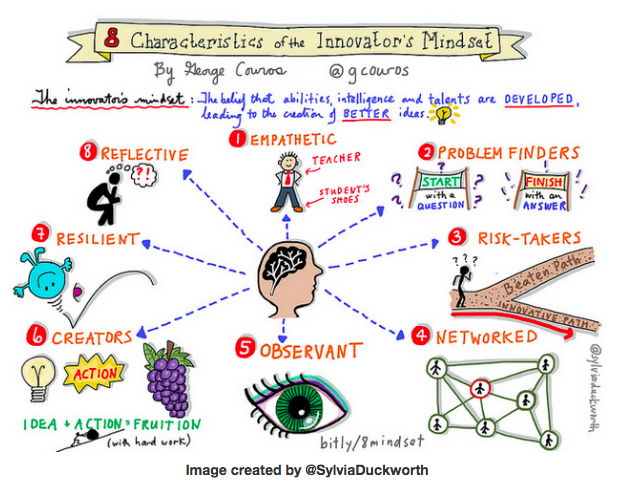
Favourite quote of the day:

George asked us, “What is one thing that has been reaffirmed today? What is one thing that has challenged you? What is one thing you are going to try?” Here are my answers: Something reaffirmed for me today was the idea that we need to let children create during their time at school! A challenge for me in teaching more innovatively has been getting technology that isn’t outdated into my classroom. Finally something I am going to try is improving my Twitter literacy.

Favourite take-away:
3 things students should have before they leave high school:
1.     A professional social network
2.     A digital portfolio
3.     An about.me page
And teachers should have these too!

Saturday, 25 October 2014

Peer into the Future of Education by Alan November

This was the conference that I attended yesterday. I have to admit that on my way there, I had been hoping that it would end early because I had so many errands to run. But it did not end early and I was not disappointed because it had succeeded in making me think! More specifically, it made me think about how technology can help us teach better than ever.

The first example that November gave us that illustrates the change in what we can teach and now expect from our students, is how we are no longer limited in the sources of information that our children have access to. If we give students an assignment to write about an event in history they are no longer limited to using only sources from their own country. They can access sources from other countries to understand other perspectives on that event and then learn from these differing perspectives.

Of course this access to other sources also means that we have lost control over what sources are available to our students and it is critically important that we teach them to analyze what they read. Two very important elements that we need to teach them is to look at who is producing the content that they read and how to confirm which of two conflicting sources is correct. The examples that November gave us for teaching who is producing content were a “.org” page owned by someone who does harm to that cause and an article that superficially looked like it was produced by a well renowned university but was actually produced by a student at that university who did not have his facts straight.

Alan November also showed us numerous websites that offer terrific learning and teaching opportunities. Here are some that I intend to explore further: Diigo, WolframAlpha, Kaizena, Mathtrain.tv, Clubacademia, ScreenChomp, Scratch, Edx, FanFiction. I have to admit that none of the things discussed at this conference were things that I could do with my early primary class that I currently teach. However I did spend much of the day thinking about what skills we should be teaching our students in the early primary grades in order to enable them to be successful learners in tomorrow’s world.


It does seem reasonable to expect that the future of learning will be more about setting up individualized learning programs for children and the teacher’s role will be to assess where a student is at and use that information to create a learning program for them. For students to get the most out of this type of a learning program it is more important than ever for them to be independent, motivated, and capable learners. This means that early on in their education we should be teaching children to learn how to learn. In my online course, Learn Easier Study Better, I stress that learning how to be a better learner involves understanding  knowing how to motivate oneself, having a “can-do” attitude, developing confidence in one’s abilities, knowledge of the learning process, and good practical learning strategies. These are all things that we can and should teach our children starting at a young age. My passion for teaching my students how to learn better was definitely fed at yesterday’s conference!

Thursday, 28 August 2014

LEARN EASIER STUDY BETTER

Learn Easier Study Better was created with middle and high school students, online learners, and adult learners returning to a student role, in mind. Typically these types of students are the ones who most need to learn how to develop their ability to learn independently, boost their confidence in their abilities and basically learn easier and study better. However anyone who feels that they could improve their learning and study abilities will benefit from this course.
This course helps these students accomplish exactly this in two main ways. First, it will increase students' meta-cognition. This is the ability to think about one's thinking. Thus students will learn to recognize what it is that they do that helps their learning as well as what they do that hinders their learning. Secondly, this course encourages students to develop a growth mindset. A growth mindset includes perseverance and a "can do" attitude. A growth mindset is more indicative of success than IQ!
In this course you, you will learn to improve and maintain your motivation and attitude toward learning, understand the learning process, increase your confidence in your learning, and learn an assortment of tricks and strategies to help you learn and study more effectively. This is taught through standard videos, narrated slideshow videos, handouts, reading texts, and key concept visuals. Students will learn through repetition, reflection, and using the three modes of learning (auditory, visual, and kinesthetic).
It should take a student 4-5 hours to complete this course. This time lime includes watching the videos, reading and viewing the text materials and doing the handout exercises. The benefits of the work that you will do in this short time will be felt throughout your life!
If you or someone you know is interested, check out my course landing page!

Wednesday, 6 August 2014

Teaching Online

Two years ago, I decided that I wanted to create an online course. I knew what I wanted to teach but I did not know how I could teach it online. Then a year ago I heard about Udemy. After checking it out I realized that this would be the perfect platform for my course! So over this past year, I have been researching, planning, and writing my course. As well, I took a course on Udemy on How to Create a Udemy Course.

The easy part is done. Now I am working on getting my course published. While writing the course I was in my element. I had been researching learning and study skills for well over a year and I am very passionate about the idea of empowering students to become more independent and in-control of their learning. Now I am plugging away at the technical aspect of creating and editing high quality videos. Ironically, I have had to take my own advice that I give in my course on maintaining my motivation, improving my confidence in my abilities, and being patient with my learning process.

When I feel stuck, I turn to three options. One, I go back to my notes or the course itself. Two, I take a break and turn to the new and improved Udemy course How to Create Your Udemy Course. After all, repetition is key! That is another key concept in my course, Learn Easier Study Better. Third, I sleep on it. Sometimes for more than one night. I think that I'm over the toughest part. So hopefully my next post will be when my course is done. Or if I need another breather, it will be on one of the books that I read this summer. Wish me luck!

Saturday, 26 October 2013

Will Richardson "Learning in a Networked World"


On October 25th, 2013, I spent the day listening to Will Richardson speak about “Learning in a Networked World”. The theme of the day was for us to consider how the world is changing and how we can best prepare our students for their futures. And to do this how we as educators can learn, unlearn, and relearn how to teach the youth of this fast-paced, globally networked world.

The following quote has been taken from the flyer advertising this event,A parent of two teen-agers, Will Richardson has been thinking and writing about the intersection of social online learning networks and education for the past 12 years at willrichardson.com and in numerous journals, newspapers, and magazines such as Ed Leadership, District Administration, Education Week, New York Times and English Journal. He is an outspoken advocate for change in schools and classrooms in the context of the diverse new learning opportunities that the Web and other technologies now offer.”

Will, frustrated with the education his children have been receiving, feels we need to stop wanting the same education for our children as the one we had. This is an amazing time to be a learner! There are so many ways for learners to connect with others, pursue their learning passions, and apply the knowledge that they learn. He likened traditional learning vs. modern learning to delivery vs. discovery. And emphasizes that the key shift to be made is from institutional learning organizations to self-organized learning opportunities.

When we were asked to reflect on the traditional notions of school and what our biggest confusions/questions are right now, the educators at the table that I was sitting at had many. How do we tap students’ curiosity in our schools? What kind of steps do we take to channel their curiosity? How do we address both students who are overly plugged in and those who are “underly” plugged in? How do we teach kids to be learning tech savvy rather than socially tech savvy? What does it mean to be educated these days?

I appreciated reading and reflecting on the NCTE 21st Century Literacies. I have listed below the ones that I would like to focus on developing in myself over then next year.
  • Design and share information for global communities to meet a variety of purpose
  • Manage, analyze, and synthesize, multiple streams of simultaneous information
  • Create, critique, analyze, and evaluate multi-media texts


Later in the day the focus shifted more towards the idea of us as educators “being a learner first and teacher second”. Will covered a number or technology tools that could be useful to us as educators. The following are the ones that caught my attention. I’ve had a Twitter account for a while but rarely use it. He helped me understand how Twitter could be used more effectively for professional development. I will definitely look into using Evernote to save articles and notes, rather than saving links in a Word document as I have been doing. I am also going to use Feedly to aggregate news sites, searches, and blogs. Later, as I develop more of an online presence I think Flipboard and IFTTT could be quite useful.

All and all I consider the day well spent. I left feeling inspired and motivated to become more of a networked learner myself! I feel better prepared for the changes that are happening and should be happening in my profession.

Monday, 14 October 2013

Engaging the Digital Learner

On October 7th, I attended a Langley School District conference titled "Engaging the Digital Learner" with four other staff members from my school.  The conference basically dealt with issues that would fall under the category of 21st century learning. Since Sandra Averill was involved in the organization of the conference, all video clips and social media involved has been posted on the Here's How Tutorials site. With Sandra we reflected on how our school uses technology and the BC Ministry of Education's Digital Literacy Standards draft. The keynote speaker was Antonio Vendramin, a principal from School District #36. He gave us some great ideas for making learning meaningful to students to keep them engaged. I was glad that he did note that methods don't need to involve technology. Two ideas I personally found quite interesting and that I would like to explore further are Genius Hour and Mystery Skype. The evening was an inspiring engagement that motivated me to get moving on exploring a few things I've been interested in as learning tools.