Showing posts with label Books. Show all posts

Friday, 21 October 2016

George Couros – Innovator’s Mindset October 21st, 2016

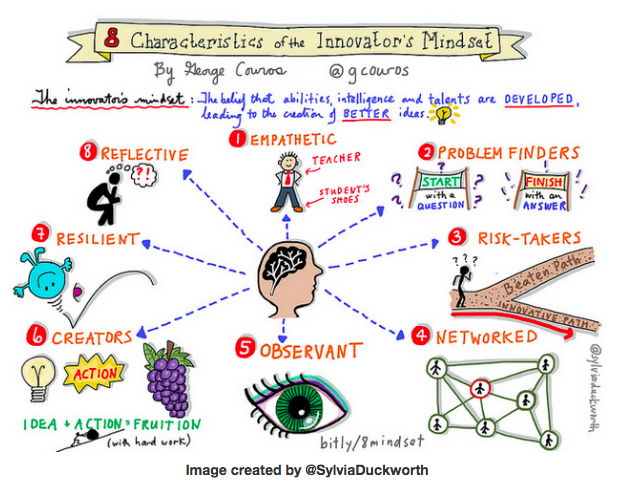
Today I saw George Couros, the author of The Innovator’s Mindset speak at the Langley Event Centre. George reminded us all that the goals of school versus the goals of learning are not always consistent and that it is our job as educators to prepare students for a largely unknown future. The best way that we can do that is to help them develop an innovator’s mindset and to do that we need to cultivate it in ourselves.

Favorite graphic of the day:
Favourite quote of the day:

George asked us, “What is one thing that has been reaffirmed today? What is one thing that has challenged you? What is one thing you are going to try?” Here are my answers: Something reaffirmed for me today was the idea that we need to let children create during their time at school! A challenge for me in teaching more innovatively has been getting technology that isn’t outdated into my classroom. Finally something I am going to try is improving my Twitter literacy.

Favourite take-away:
3 things students should have before they leave high school:
1.     A professional social network
2.     A digital portfolio
3.     An about.me page
And teachers should have these too!

2015/16 Ongoing Professional Development Throughout the School Year

In addition to professional development days, which I was negligent in blogging about this school year, two great Pro D opportunities I had was the collaboration/inquiry time worked into our school year and a book club at my school.
During the Inquiry/Collaboration time, I delved into the question of whether online Fresh Grade (FG) portfolios could improve my communication to parents about their children’s learning. Working with five other teachers at my school, we all found that it was a terrific tool for communicating what we were doing in the classroom and where each child was at with their learning. We could post pictures for the whole class to show parents activities like a Science demonstration, a group writing collaboration, a guest presenter or even a class demonstration of a dance. This provides parents with an insight as to what their child actually does at school and can help them further the discussion if their "what did you do at school today?" question is answered with "nothing" or “I don’t know.” FG also has an announcements feature that allows a teacher to send out an announcement such as a reminder and parents will be notified via a pop up if they have the app and an email. I would say the most powerful feature of FG is the ability to post pictures and videos of a student to demonstrate where they are at with their learning. For example, we posted pictures of drawings, projects, writing samples, and assessments as well as videos of counting, reading, and answering open ended questions. These can then have a note attached to them explaining what the teacher was looking for. If you attach a learning outcome to these activities and assess them as you post them. These learning outcomes and their attached assessment will be automatically used when you create a report card for your students. We all found FG to be such a useful tool for communicating with parents that we are each using it again this year. We received lots of positive feedback from parents.

Another ongoing learning experience that I enjoyed was a book club hosted by our vice-principal, Kim Anderson for Catching Readers Before They Fall by Pat Johnson and Katie Keier. A group of us met regularly throughout the year to discuss the chapters as we read through the book. I found this a great experience! Although I had pretty much learned most of the strategies and concepts brought up in the book through professional development over the last 21 years, it really helped freshen my perspective. There were so many ideas that I came across and realized that I either hadn’t done them in awhile or I had meant to incorporate them into my teaching at some point and then never did. As well discussing the topic of teaching reading to the students who don’t pick it up easily was valuable. We shared our ideas on how to find the time to spend the extra time needed with these learners. I’m very grateful for this learning opportunity!

Wednesday, 13 August 2014

Willpower: Rediscovering the Greatest Human Strength

This summer, I reread Willpower: Rediscovering the Greatest Human Strength by Roy F. Baumeister and John Tierney. This book basically discusses willpower in terms of self-control and self-regulation.The one chapter in this book that is most pertinent to raising children would be “Raising Strong Children: Self-Esteem Versus Self-Control”.

The biggest point that the authors make is that in the 1980's there was a big push to raise children’s self-esteem so that they would succeed better. But as more research was done, it was discovered that high self-esteem did not result in more success and better achievement. This initial assumption had it backwards because what was really at work was that when children experienced success and accomplishment, it raised their self-esteem. In fact all the general praise and recognition that we have given children when success and achievement was not even there has actually caused the societal problem of narcissism. The authors define narcissism as, “the self-absorbed conviction of personal superiority.”

Narcissism has been on the rise in North America for decades. What is the problem with narcissism? This chapter lists some of the big issues such as professors complaining that students feel entitled to high grades without having to study, and employers report problems with young workers who expect to have all the benefits of a high level executive job without actually paying their dues. In fact, news reports have stated that the under 34 age group has the highest rates of unemployment and college professors and teachers have also complained about parents expecting their children to get high grades without earning them. One documentary that highlights the issues of narcissism in today’s youth is CBC’s Hyper Parents, Coddled Kids.  Although it does not use the word narcissism, as you watch it you can see that narcissism runs rampant in the examples that it highlights.

 In this chapter, Baumeister and Tierney point out how the Asian parenting philosophy actually promotes self-control and results in the youngsters raised in this manner outperforming their peers, even outperforming their peers with higher IQs, which was once thought to be indicative of success. Youngsters raised in this manner do not exhibit high levels of narcissism. Typically, Asian cultures expect a higher level of self-control from their children even at an early age. An example would be expecting toddlers to be potty-trained at younger ages. As well, delayed gratification plays a large role in raising children. Not giving their children a big-ticket item until they have achieved a particular accomplishment.  Mothers who emigrated from China most frequently mentioned setting high goals, enforcing tough standards, and requiring children to do extra homework.
 
Following the discussion on Asian parenting styles and their flourishing children, the authors then bring up examples of low expectations of American raised children that has allowed the nanny reality television shows to boom.  These nanny shows typically show a home where the children are running wild and then a nanny comes in and establishes structure and discipline that is consistent above all else but also as immediate as possible. Consistency is the most important rule of discipline. The consequence itself does not need to be over the top. In fact it can be as mild as some firm words. It is good to have the consequence follow the misbehaviour as soon as possible for it to be as effective as possible.

This chapter also points out that “nearly all experts agree that children need and want clear rules, and that being held accountable for obeying the rules is a vital feature of healthy development.” As well, children need monitoring   to develop a healthy sense of self-control. It has been found that a lack of adult supervision during the teenage years turned out to be one of the strongest predictors of criminal behavior. Children whose parents keep tabs on them are less likely to use illegal drugs. Parental monitoring helps kids develop self-control when parents remind and expect their children to behave according to standards that have been expressed and taught at home. Controlling one’s attention is also a crucial part of developing willpower. Television, even if it is quality programming does not teach people to control their attention. Reading, role play games, and other games that engage a child’s attention and focus for longer periods of time will help children learn to control their attention. That is a lot of valuable information packed into one chapter for parents, caregivers, and educators, to dig into when improving their ability to raise children with a healthy dose of self-control.


Saturday, 22 March 2014

Focus: The Hidden Driver of Excellence

This past winter, I read Daniel Goleman's Focus: The Hidden Driver of Excellence. I have been meaning to write about it for awhile because of the obvious connection to education and why and how we can teach children how to focus better. Then today I came across the webinar Education for Today: Rethinking Skills for Success with Daniel Goleman and Peter Senge, which reminded me that I wanted to process my thoughts about the book.

Daniel Goleman, in this book, explains three kinds of focus: Inner focus, Other focus, and Outer focus. Inner focus is the ability to tune into ourselves and determine what we are feeling, where the feeling comes from, and what we can do about it. Other focus is tuning into others and developing and understanding necessary for developing solid relationships. Outer focus is tuning into the world around us and understanding how things work and the consequences of actions.

Teaching students these kinds of focus will help them live happier more successful lives as the skills involved for these types of focus are exactly the skills that Richard Boyatzis argues make for better leadership in his course Inspiring Leadership through Emotional Intelligence. See my post below on this course. These skills are addressed and taught in Social Emotional Learning (SEL) curriculum. Research has found that SEL programs increase pro-social behaviors by 10%, decrease antisocial behavior by 10%, and increase academic performance by 10%. One major strategy for developing all these types of focus is teaching mindfulness. See my posts on mindfulness.

In the webinar mentioned above it is argued that the there are three crucial skill sets that need to be taught for student success in life. The first is self-mastery which is essentially the skills that Goleman explains are part of inner focus. The second is empathy and caring which is basically the skills involved in other focus. The third skill set is systems understanding which relates to the skills involved in outer focus.

If there is one thing that has become clear in education to those on the front lines these days is that our education system needs to teach more than just reading, writing, math, and other academic subjects. My major concern with the current push for project based learning is that if we do not teach children these three kinds of focus that Goleman explains in his book (or the self regulation that Stuart Shanker promotes) then many children will not succeed. Students without focus will not get much out of project based learning. When so many students are struggling with self regulation issues, inner, other, and outer focus can help them succeed and live happier lives.

Monday, 30 September 2013

Stuart Shanker and Classroom Strategies for Self-Regulation

Another pivotal aspect of my professional development in the 2012/13 school year was attending an presentation on Classroom Strategies for Self-Regulation by Stuart Shanker put on by the Langley School District. I attended this presentation with my staff early on in the school year and we were all impressed with Shanker's ability to speak to us about increasing needs of the children passing through our classrooms these days. It was great to have a term to hang on these needs that have been such a demand in our profession as of late, "self-regulation." Shanker helped us see the various aspects or domains of these self-regulation needs, biological, emotional, cognitive, social, and prosocial. He also gave some practical strategies that we could implement to promote a calmer learning environment. I was so impressed with the ideas presented that I purchased his book, Calm, Alert, and Learning.
Calm, Alert And Learning: Classroom Strategies For Self-regulation
This book has made a significant impact on my teaching style and helped me embrace my un-teacher like quality of not wanting the walls of my classroom to be so bright and crowded with visuals! The ideas in this book complimented the MindUp curriculum. I am sure to write more about the ideas I have learned and put into practise from this book. I am looking forward to reading more by Stuart Shanker and his thoughts and research on the subject of self-regulation!